School Daze – Awaken Your Children to Music

We can all remember sitting in class daydreaming about other things rather than listening to the teacher lecture about a subject we found uninteresting. Kids today really haven’t changed. They are the same everywhere. Maybe they need to find a subject they can not only learn but where they can interact—how about waking them up to music!

Why indeed, should kids take music classes in school? There are so many reasons that it would take this entire article to enumerate them all. Besides being fun, one of the most significant aspects of taking school music classes is students who enroll in music classes do much better in other academic courses than students who do not take school music. This fact is proven and replicated numerous times in scientific research studies and should not be ignored by parents.

We are fortunate indeed that our local Tri-Valley school districts offer a full range of music courses in the elementary, middle and high school grades. These courses are both for the nonperforming, and performance oriented student in band, orchestra or chorus. Also many surrounding communities offer community bands where one can continue to play music for a lifetime.

My own experience with school music really changed my life due to Richard Hansen, my high school band director at Acalanes High School. He was such a positive role model and made music come alive for me. He encouraged me to seek a career in teaching music.

Because of my experiences in school music, I gained the most rewarding career a person can have—teaching high school and college classes as a music educator and band director.

In years past, school music has been justified on non-musical extrinsic values rather than on its own intrinsic merits and worth. Citizenship and character was at one time a primary goal of music education. Its function was to create moral, upright children who evolved into productive citizens. A favorite saying was: “Teach Johnny to blow a horn so he won’t blow a safe later.”

Health was another reason for teaching music in schools. Musicians develop lung-power through proper breathing. At one time schools gave Physical Education (PE) credit for Marching Band—marching up and down a field is good exercise equivalent to strenuous exercise in some PE classes.

As a result of Sputnik, in 1957, American education was thought to be behind the Russians, especially in math and science. Almost immediately, new programs in math, science and language were being developed and adopted in American schools. The arts were left behind in the mad rush to catch up to the Soviet Union. Music as an academic discipline became the new rallying cry to justify music in schools.

Music courses were restructured to be more academic in nature and reflect what is really important in a child’s education. One of the goals of this new approach to music education was to “teach students to perceive expressive elements in a wide range of musical genres and styles,” from, Foundations and Principles of Music Education by Leonhard and House.

Today, teaching music in the schools is accomplished by teaching music history and music literature. Very important in the learning process is developing skills, including listening; responding; singing; playing instruments; reading and writing music. The development of attitudes and appreciation and the ability to decide the worth and value of music are essential in teaching music. “Music, like language, is an accomplishment that distinguishes us as human,” writes J. Vudkin, in his book, Understanding Music.

A resolution adopted by the American Association of School Administrators said: “It is important that pupils, as part of general education, learn to appreciate, to understand to create and to criticize, with discrimination those products of the mind, the voice, the hand and the body that give dignity to the person and exalt the spirit of man.”

“The primary purpose and goal of music education is to develop aesthetic sensitivity to music, that is, to heighten the quality and impact of musical experiences,” originally adopted from (in 1971 and again in 1989) the Visual and Performing Arts framework of the California State Department of Education. Also, music in the schools was recognized by law as a core subject along with math, science, language and history in both the Educate America Act and the No Child Left Behind Act, in 2001. It has been said that, “It is evident that education without the fine arts is fundamentally impoverished and subsequently leads to an impoverished society.”

After retirement from teaching, my wife and I started the Danville Community Band that now has a roster of 90 volunteer musicians ranging from ages 15 to 80 plus. One is never too old to enjoy playing music and the younger one starts, the better. Each year, the band donates a musical instrument to local deserving students in middle and high schools.

Please call your local school and speak to the teachers, both instrumental and choral, about music classes your child can take. It many cases it can be a life changing experience and can be enjoyed way beyond the school years. Don’t let your child miss out—awaken them to the world of music! They will thank you for years to come.

Please submit your questions and comments to banddirector01@comcast.net

Visit our website at www.danvilleband.org for up-to-date information about the Danville Community Band.


Share

Volunteering – for Others – A Reward in Itself

Many of us, even with our hectic daily schedules, find that we have a few spare hours a week when we are relatively free of demanding responsibilities. The question is, what do we do with these free hours? I’m afraid a lot of us waste time with inane, nonproductive and unnecessary activities. Instead, how about volunteering for some community organization that really needs help? It will make you feel good knowing that you are helping others that may not be as fortunate as you.

Webster defines volunteer as: A person who of their own free will offers themselves for a service or duty. This service is freely given without the expectation of a tangible reward. One should never expect something in return for volunteering their services. Volunteering is generally considered to be an altruistic activity. To volunteer is an unselfish interest for the welfare of others.

Research has proven the positive rewards of doing for others and finding meaning in volunteerism. I find it extremely satisfying to be in two organizations that are very dear to my heart. These are the Danville Community Band (DCB) and the world-renowned Blackhawk Auto Museum. Many readers know that my wife, Jan and I founded the DCB in 2001. Locally, I am also a charter docent at the Blackhawk Museum. Both of these organizations provide opportunities for me to volunteer my skills and abilities. There is no monetary compensation but the rewards I gain are far greater than money.

Church work; museums; community music groups; schools; Red Cross; Salvation Army; hospitals; nursing homes; senior centers; service clubs; scouts; tutoring; veteran organizations; and many more are just a few examples of local volunteer opportunities.

The benefits of volunteerism are numerous: self-satisfaction; a way to learn new skills; relaxation; meet new friends; career opportunities; and community improvement.

Working with the band and the museum give me great satisfaction and joy and mostly, I get the feeling I have given of myself for the possible betterment of others.

Danville Community Band

Since my wife and I started the band 10 years ago, we have both given hundreds of hours to insure the success of the organization. The two hours of rehearsal each week are nothing compared to the number of hours spent each week doing behind the scenes organizational activities.

All ninety members of the band are also volunteers who unselfishly give up their time each week to rehearse for the concerts we present to the community at various times of the year. That, of course, is in addition to the amount of time spent practicing at home.

Many of the musicians volunteer even more time serving in various offices and on special committees for the band. The DCB is a great example of community volunteerism. The band members devote many hours for the artistic betterment of the community and surrounding environs. The band can always use volunteers – even if it’s only passing out programs at concerts – we’d love to hear from you if you can volunteer. (See below)


Blackhawk Museum

Since I have been a charter docent from the opening of the museum in, 1988 to the present, I have given many tours for school groups, senior citizens, auto club members, and other private/public tours. In addition to conducting tours there are numerous opportunities and occasions for volunteer work at the museum. These involve being gallery hosts and guides for functions including meetings, banquets, lectures, celebrity events, wedding receptions and many other varied activities.

The museum offers docent training programs for prospective volunteers. One must take a free class to become a docent. Volunteering at such a “world class” venue is rewarding indeed. A museum volunteer also informs the public about the educational offerings that the museum provides. One of the main functions of the Museum Guild is fund raising. It has been said many times that the museum could not run without the volunteers. To learn more about the museum volunteer program contact Jill Brennan, volunteer coordinator. For information regarding the docent training program contact Dr. Nora Wagner, head of the docent training program. Both can be reached at: 925-736-2280.

Remember, the more you do for others the more rewards you will reap and many others will benefit from you unselfishly giving your time and talents to those in your community. Volunteering is a great reward in itself.

Please submit your questions and comments to banddirector01@comcast.net

Visit our website at www.danvilleband.org for up-to-date information about the Danville

Community Band.
_______________________________##___________________________________


Share

Can Music Help Relieve Pain?

According to numerous research studies the question – can music help relieve pain? is answered by an emphatic, yes! Experts have shown that music has great benefits for those with various kinds of pain.

Background

For hundreds of years professionals involved in health care have used music in some form to treat illness in both mind and body. These reports were basically of a nonscientific nature. However, scientific studies done in recent years have measured the benefits of treatments involving music.

Music Therapy
Because music can influence us both physiologically and psychologically it is receptive to treatment by trained music therapists. Music is an important area of therapy for stress management. Also biofeedback, guided imagery and other techniques play an important role in the treatment of people with stress-related disorders, according to Researcher, Jane Collingwood.

Recent Findings
“Listening to music can have a tremendous relaxing effect on our minds and bodies, especially slow, quiet classical music,” wrote Collingwood in an article, The Power of Music to Reduce Stress. “This type of music can have a beneficial effect on our physiological functions, slowing the pulse and heart rate, lowering blood pressure and decreasing the level of stress hormones.”

“In our hand therapy clinic at Webster Orthopedics in San Ramon, we select and play music that enhances the patient’s rehab experience and fosters a healing environment,” said Certified Hand Therapist, Deborah Vanderbilt-Anderson.* “Studies have substantiated the positive effects of music on chronic pain, pre and post-operative pain, as well as anxiety related to injury or illness,” said Vanderbilt-Anderson. “Some of our goals in working with pain management are to teach techniques to reduce muscle tension, reduce anxiety and stress, increase muscle control and improve breathing,” she explained. Techniques such as progressive neuromuscular relaxation (PNR), diaphragmatic breathing, visualization and biofeedback are all enhanced when playing light, soft music.

“Half an hour of music produced the same effects as 10 mgs. of Valium,” said Dr. Raymond Bahr of St. Agnes Hospital in Baltimore.

Dr. Sandra Siedlecki, of the Cleveland Clinic Foundation, discovered that people in two music groups had a statistically significant effect over the control group that had no music exposure. The music groups had reduced pain, depression and disability and increasing feelings of power over their pain. The control group had no exposure to music thus did not experience the benefits of the two music groups.

Listening to music helps reduce pain by activating sensory pathways that compete with pain pathways thereby stimulating emotional response. Music, therefore, provides meaningful, intellectual and emotional engagement to help reduce pain.

“Music may have the most benefits for the anxiety-prone,” said Researcher, Denise Mann in a study, Music Can Ease Pain. “Engaging activities, like listening to music may be most effective for reducing pain for anxiety in persons who easily become absorbed in activities.” Researchers measured participant’s responses to pain via electrical activity in the brain, dilation of their pupils and other methods. These methods are considered more objective than self-reports about pain.

Listening to music is an excellent means of reducing stress and physical pain,” said Dr. Harris Mcllwain, in The Journal of Pain. Anahad O’Connor reports music exposure reduces pain responses. People who are anxious may find listening to music especially effective in helping to relieve pain.

There is almost universal agreement among researchers and pain management professionals that music can indeed help reduce pain in people who suffer from both mental and physical pain. Most professionals advocate that pain management treatment be under the guidance of trained professionals that are recognized experts in their field. This is not an area where amateurs should dabble.

There is a caveat however, not all people with varying kinds and degrees of pain will find relief listening to music. The positive side of the question is a significant percentage will find some real relief.

For people with chronic pain and distress – there is hope. There are many avenues for pain reduction or elimination. Music can be a source of non-drug intervention, the research says it can work – it may work for you – why not give it a try.

*The idea for this article was contributed by Deborah Vanderbilt-Anderson (MOTR/L, CHT) Certified Hand Therapist for Webster Orthopedics in San Ramon, CA.

Please submit your questions and comments to banddirector01@comcast.net
Visit our website at www.danvilleband.org “>www.danvilleband.org for up-to-date information about the Danville Community Band.

Share

Pomp and Circumstance

Every spring in the month of June, hundreds of thousands of high school and college students graduate at special commencement exercises across the United States and many other countries. What is common to almost all commencements is the music that is part of the ceremony.

As Christmas carols are unique to the holiday season so is one particular piece common to most of these graduation exercises. That piece is Edward Elgar’s Pomp and Circumstance March. It is probably the most played piece of music in the month of June, literally performed thousands of times. Unfortunately, it is rarely heard at other times of the year. This is regrettable, as this is a great piece of music that would be an excellent selection on any concert program.

The March

The Pomp and Circumstance March is not just one piece but one of five marches all called Pomp and Circumstance. The one that is most played today is number one in D. It was premiered in 1901 and became very popular almost from the beginning of its public performances. Elgar actually wrote some sketches for a sixth march but it was never completed. The Sousa band recorded number one as early as 1904.

“Written with an honest pride in Britain’s love of ceremony, the march’s melody was requested by King Edward VII to be used as the coronation ode theme in 1902,” according to Norman E. Smith’s March Music Notes. An interesting side note is, for years it was the required accompaniment for newsreel glimpses of Britain’s Royal Family.

In regard to the slow section or trio in the march, Elgar said, “I got a tune that will knock’em – knock’em flat! A tune like that comes once in lifetime.” The trio section would later be named. Land of Hope and Glory.

 
The Composer

Sir Edward William Elgar (1857-1934) was born in Broadheath, England into a musical family of modest means. His father was a musician who for 37 years was primarily an organist at St. Georges Catholic Church. When the senior Elgar was not working at his music shop he also composed and arranged pieces for different combinations of instruments. Therefore, it was not unusual that Edward received his early musical training from his father.

Elgar had varying abilities on a number of instruments including: violin, organ (he often substituted for his father at the church), bassoon, cello and trombone. Young Elgar had a practical working knowledge of these instruments which was valuable for writing his compositions.
 
Considering his advanced compositional skills it is interesting to note that he was basically self-taught after his early training by his father. He has been described as a self- taught ‘Edwardian’ Englishman.

The road to pre-eminence as a composer of international fame was not an easy one. He was a Roman Catholic in predominantly Protestant England, a Victorian provincial society.

In the 1880’s and the 1890’s his style matured and he gained valuable experience as he conducted and composed for local musical organizations. Just after the turn of the century his reputation gained considerable acclaim and he began to garner awards and honors. Elgar was knighted in 1904 and numerous honorary degrees followed not only from English Universities such as Cambridge and Oxford but from Universities from other countries including the United States.

In 1905 he was invited to Yale University to receive an honorary Doctor of Music degree. At that commencement ceremony Pomp and Circumstance was played as a recessional. This was most likely one of the very first times it was used as a graduation march. Today it is usually used as a processional in high schools and colleges.

Elgar was one of the first composers to take the gramophone seriously. Between 1914-1925, he conducted a series of acoustic recordings of his compositions. Musicologists have said that Elgar was the first English composer to win international recognition in more than 200 years.

His other well known compositions are the Enigma Variations of 1899 which was his first big success and his two symphonies Number One in A Flat and Number Two in E Flat. Elgar, of course, wrote many other pieces in all forms of music.

H.D. McKinney and W.R. Anderson in their book Discovering Music wrote: “in many ways he was the typical nineteenth century Englishman; he was the consummate craftsman, the reserved, proud, thorough gentleman.”    
Mark your calendar for the Danville Community Band’s annual free Spring Concert, Sunday, June 17, 3:00 p.m. at Community Presbyterian Church, 222 West El Pintado in Danville.

Please submit your questions and comments to banddirector01@comcast.net
Visit our website at www.danvilleband.org for up-to-date information about the Danville Community Band

Share

Successful Careers from Mediocre Beginnings

Many famous and successful people, including musicians and composers, abound in our present day society. But many of these highly-thought-of, very accomplished people were not as famous and successful in their early lives as they became later. Many people who we admire and esteem today had very mediocre career beginnings.

It is surprising to note that when I was doing research for this article I found world renowned individuals represented in the fields of business, politics, science, medicine, sports and the arts including musicians and composers.

When we think of the gifted and illustrious composers of the past few centuries and even in modern times, most people would not have imagined they had hard times and unfortunate periods in their lives. Some examples of these famous people follow:

Musicians and Composers

Wolfgang Mozart (1756-1791) was a prodigy and wunderkind, musically gifted beyond belief. He was proficient on the harpsichord at the age of four and composing at age five. However, he was often restless and even dismissed as a court musician in Salzburg, Austria. Mozart struggled to support his family financially and was always in need of his patron’s commissions. He died at the untimely age of 35, destitute. It is said that his early demise was brought about by overwork and financial worries. In his short life he wrote over 600 compositions. Think what this output would have been had he lived a normal life span.

Ludwig Van Beethoven (1770-1827) was one of history’s greatest composers. As a youth he was awkward on the violin, reportedly due to non-practice. He was described as an angry young man mainly due to his father’s browbeating and bullying. One of his teachers said of him, “As a composer he is hopeless.” Deafness is a tragedy for anyone but for a musician/composer it is catastrophic. Deafness changed Beethoven’s whole personality and he became “A miserable old grump.” Unbelievably he composed his later works when he was totally deaf. He evolved from his early inadequacies to become one of the greatest composers of all time.

Igor Stravinsky (1882-1971) enjoyed tremendous acclaim and success, especially from his ballet scores in his later years. He was literally run out of town after the premier of the ballet Le Sacre du Printemps (the Rite of Spring) in 1913.” Le Sacre du Printemps provoked a riot – nobody was ready for this extraordinary portrayal of ancient fertility rites with savage harmonies and irregular pounding rhythms. “Le Sacre du Printemps is a primitive, ritualistic breathtakingly modern, and the most single influential piece of twentieth-century music,” according to Marcus Weeks in his book, Music.  Stravinsky’s life is a story of rejection to adoration and he was a champion of twentieth-century music.

Elvis Presley (1935-1977) was a true American Icon who came from being literally a “nobody” to an international box office phenomenon. In 1954 Jimmy Dean, who was the manager of the Grand Ole Opry, fired Elvis after just one performance. “You ain’t goin’ nowhere, son,” said Dean. “You ought to go back to driving a truck.”  If anybody ever had to eat their words, it was Jimmy Dean!

Henry Mancini (1924-1994) award winning, Oscar winning, Grammy winning musician/composer/arranger was another success story that had a rough beginning. His daughter, Felice Mancini, writes, “My father was not a good student. He got D’s and occasional F’s and many C’s throughout his school years. But he seemed to shine when it came to music and got A’s on every report card. He was fortunate to have music available to him and teachers who recognized his gift.” Mancini’s greatest claim to fame was being a staff composer and arranger at Universal Studios. He was the first to introduce Jazz to television and film scores that made his work unique. His compositions became huge hits among some are: Pink Panther, Moon River, Days of Wine and Roses, Breakfast at Tiffany’s and TV theme songs, Mr. Lucky, Peter Gunn and Charlie’s Angels. Mancini also wrote and arranged for Glenn Miller and Benny Goodman.

Other famous non-musicians with dubious beginnings are:

Henry Ford, who had early failed businesses and went broke five times.

R. H. Macy had seven failed businesses before his department store empire.

Colonel Sander’s recipe was rejected over 1,000 times before a restaurant accepted it.

Bill Gates dropped out of Harvard and had a failed first business.

Walt Disney was fired from a newspaper because “he lacked imagination and had no good ideas.”

Winston Churchill struggled in school and failed sixth grade. He was defeated in many elections before he was twice elected Prime Minister and a Nobel Prize winner. He was recognized as being one of the world’s greatest orators and Churchill was also a very prolific writer.

Overcoming obstacles early in life can often lead to successful careers. Having a positive attitude and preparing yourself for your future career is most important for success. Don’t be discouraged by early disappointments as the future may hold great things.

Mark your calendar for the Danville Community Band’s Annual Free Spring Concert, Sunday, June 17th, 3:00 at Community Presbyterian Church in Danville

Please submit your questions and comments to banddirector01@comcast.net

Visit our website at www.danvilleband.org for up-to-date information about the Danville Community Band.
 

Share

Classics to Pop

Many of us find ourselves humming or singing a favorite tune or other songs we know while driving or in the shower. But how many of us think about how or where the song came from?  We may or may not know the composer, but is the song their original material or did it come from somewhere else? Believe it or not, many so-called modern songs originated from classical music.

The great master composers of the seventeenth, eighteenth or nineteenth centuries apparently had no qualms about “borrowing” or “lifting” tunes from each other. Musical literature is rampant with this questionable practice. I suspect that plagiarism was not the big deal in those days as it is today.

Most, but not all youth today, view the great music of the past as not relevant, out of step with the times and even boring. Creative and imaginative teachers use this phenomenon of classics to pop to teach students classical music by showing them how themes are adapted into pop/ rock musical genres. The aim or goal in this type of instruction is to show that all types of music are important and should be appreciated.

Instruction may include having students listen to the original classical theme then listen to its adaptation into popular music. In this way students learn about the classics if pop music is used to introduce it in a non-threatening and interesting way. These classes have been shown to be most effective when teaching modern day students.

The hope is that students, through this type of teaching about music they didn’t understand or appreciate i.e. classical music, would come alive for them and eventually assure its survival in the world.

The following illustrates the popular music that was generated by the great classical composers of the past:

  • 1890’s -“O Promise Me” from the musical Robin Hood based on an Italian opera Mala Pasqua
  • 1910’s -“I’m Always Chasing Rainbows” from Fantasie Impromptu by Frederic Chopin; “The Marine Hymn” from Gendarmes Duet by J. Offenbach
  • 1920’s -“Going Home” from the Largo from Dvorak’s Symphony #9 – The New World
  • 1930’s -“Song of India” from the Song of the Indian Guest from Rimsky-Korsakov’s Sadko; “In an 18th Century Drawing Room” from Mozart’s Piano Sonata K. 545
  • 1940’s -“Tonight We Love” from Tchaikovsky’s Piano Concerto #1 this was Freddy Martin’s theme song “Till the end of Time” from Fredric Chopin’s Polonaise in A Flat
  • 1950’s -“Stranger in Paradise” from the Broadway musical Kismet, based on Alexander Borodin’s Polovetsian Dances. Also from Borodin is Baubles, Bangles and Beads; “Catch a Falling Star” from J. Brahms Academic Festival Overture
  • 1960’s -“It’s Now or Never” based on Elvis Presley and also O Sole Mio, “Hello Mudduh, Hello Fadduh” from Ponchielli’s Dance of the Hours; “A Groovy Kind of Love” based on Sonatina in G Major by M. Clementi
  • 1970’s -“Pictures at an Exhibition” by Emerson Lake and Palmer from M. Mussorgsky’s Pictures at an Exhibition; “Could it Be Magic” inspired by Chopin’s Prelude in C Minor;
    “A Fifth of Beethoven” – a disco version of Beethoven’s 5th Symphony; “Night on Disco Mountain” from M. Mussorgsky’s Night on Bald Mountain
  • 1980’s -“Midnight Blue” from Beethoven’s Pathetique Sonata; “Rock Me Amadeus” from Falco; “Mars” from Mars the Bringer of War from Gustav Holst’s The Planets
  • 1990’s -“All Together Now” based on chord progressions from Pachelbel’s Canon; “Everythings Gonna Be Alright” from Bach’s Air on the G String; “Love of My Life” from J. Brahms 3rd Symphony
  • 2000’s -“Remember” from Tchaikovsky’s Swan Lake; “Road to Joy” from Beethoven’s Ode to Joy in the 9th Symphony; “Lacrymosa” based on Mozart’s Lacrymosa movement from the Requiem; “Yatta” from Pachelbel’s Canon

It is interesting to note that in my research I found many more popular songs were based on Pachelbel’s Canon then any other musical source.

The above list is far from complete. This is just a sampling of some of the most well known songs. There are too many to mention in this brief space. The number of modern day composers using classical themes in writing popular songs is nothing short of staggering. The next time you hear classical music being put down, remind that person that there is a good chance they are hearing a classical theme that inspired the popular song they are hearing.

Please submit your questions and comments to banddirector01@comcast.net

Visit our website at www.danvilleband.org for up-to-date information about the Danville Community Band.
Share

The President’s Own: The United States Marine Band

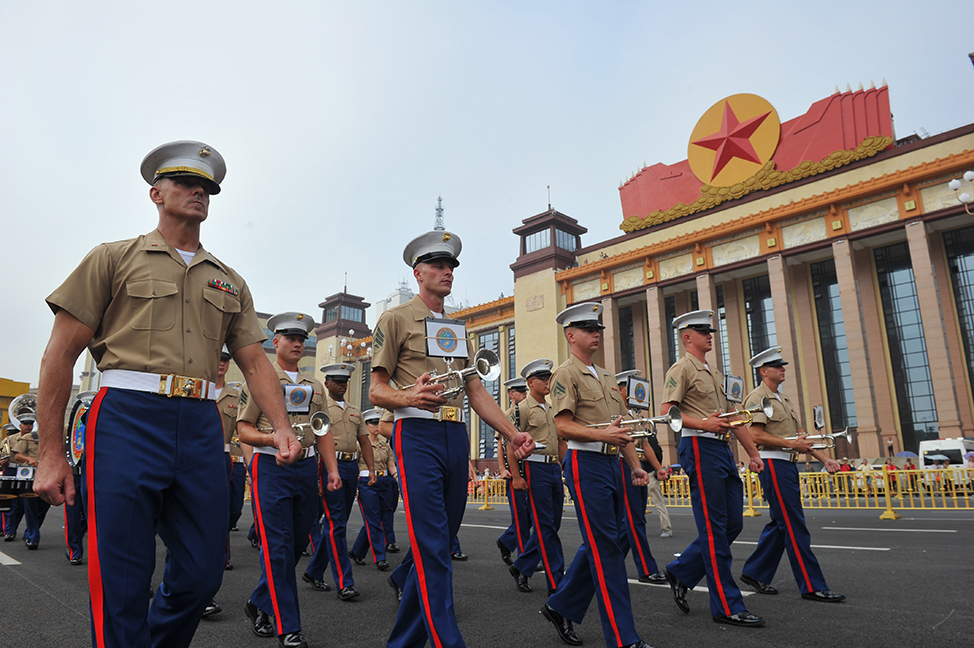
The oldest musical organization in the history of American Military music is the United States Marine Band. It is also the oldest professional musical organization in the country. It was created in 1798 by an act of Congress and signed by President John Adams. Adams invited the band to play at the Executive Mansion. It was designated “The Presidents Own.” Thomas Jefferson had the band play at his inauguration. Since then the Band has played at every presidential inauguration.

“Military bands educate, entertain and inspire the audiences for whom they perform and their history is far reaching,” said Mark Cantrell in an article from Military Officer “Strike up the Band.”

February marked the birthdays of two of our most famous and historically significant Presidents—George Washington and Abraham Lincoln. This also happens to be an election year complete with all the hoop-la, pomp and celebratory events that go along with it. Our nation’s military bands will be doing yeoman duty before and after the elections.

In an earlier article, “Music Careers in the Military,” (October 2009) I briefly described the nation’s military bands including: the bands of the Army, Navy, Air Force, and Coast Guard and of course, the Marine Band “The Presidents Own.”

The Marine Band is by far the oldest military band in the nation. It is housed in the Nation’s Capitol, Washington, D. C. The band and many of its smaller units Chamber Orchestra, Dance Band, Jazz Combos, Drum and Bugle Corps and other small ensembles play regularly at the White House – hence the name “The Presidents Own.”

The Marine Band first played a concert on radio in 1922. After that auspicious event the band played weekly radio concerts for the next 24 years.

Each fall, “The Presidents Own” performs concerts for tens of thousands of people in communities across America on its annual concert tour. The band performs at many venues both in the country and abroad. In October of each year the band performs on a month-long tour in different sections of America. They generally play to packed houses making it quite difficult to get a ticket. Needless to say they are very popular. That tradition of touring was started by none other than John Philip Sousa – the 17th director of the Marine Band.

John Philip Sousa
Any description or historical facts about the band would be incomplete and remiss without mention of its most famous director. Sousa was born in 1854. His father was a trombone player in the Marine Band. Sousa’s musical aptitude and talent was recognized at an early age. His father enlisted him in the Marine Band as a boy apprentice musician when he was 13 years old-after he tried to run away to join a circus band.

In 1880 at the age of 26, Sousa was appointed conductor of the Marine Band, a post he held until 1892 when he resigned to form his own band. He led the Marine Band under five Presidents.

During World War I he was commissioned a Lieutenant Commander in the United States Naval Reserve and led the Navy Band at the Great Lakes Naval Station near Chicago. After returning to his own band at the end of the war, he continued to wear his naval uniform for most of his concerts and other public appearances. Sousa died in 1932. Ironically he was quoted as saying, “When you hear of Sousa retiring, you will hear of Sousa dead!”

When enlistments are up or bandsmen retire, nationwide openings are posted for certain positions in the Marine Band. Rigorous auditions are held for the most proficient musicians. Candidates must be very advanced, accomplished and of symphony orchestra caliber to be chosen. Many are graduates of the nations top music conservatories. Many of them hold masters degrees in performance. They must also be physically and emotionally able to carry out military duties and responsibilities. Bandsmen sign a four year contract and start at the rank of Staff Sergeant.

The Marine Band produces recordings for educational purposes and to enhance the public affairs and community relations of the United States Marine Corps. To learn more about the Marine Band audio resources and download music visit www.marineband.usmc.mil/audio_resources.

If a person loves to play his/her instrument and wants a good job with excellent benefits and salary – why not a career in a service band? What a great way to do what you love and also serve your country.

Please submit your questions and comments to banddirector01@comcast.net.
Visit our website at www.danvilleband.org for up-to-date information about the Danville Community Band.
Share

Bluegrass Anyone?

If you have heard or been exposed to bluegrass music, you most likely responded viscerally in one way or another. It is a toe-tapping, hand-clapping, body-moving, head-nodding brand of exciting, American music. It is almost impossible not to get physically involved with this art form. “Bluegrass music has a way of creeping into your soul and staying there,” said Jason Borisoff in an article entitled The Lonesome Language.

Origins

Although, bluegrass music has elements of English, Scottish, Welsh, Irish, and German influence, its roots were inspired by immigrants living in rural towns and villages in the Appalachian Mountains. The music was further enhanced by African Americans.

Early on, bluegrass music was used to accompany the rural area dances known as clogging, flat footing or buck dancing. This genre of music wasn’t called bluegrass when it first evolved. It was simply called “old time mountain hillbilly music.” In the early part of the 20th century, this form of music slowly made its way into larger areas (cities). It no longer was just an accompaniment for dances, but was listened to for its own intrinsic value by a growing number of fans.

Music historians cannot pinpoint a date when this musical form was first called bluegrass but they agree it was in the early 1950’s. It was named after the father of the genre, Bill Monroe. Monroe was from Kentucky (the bluegrass state). He formed a band in 1939 and named it “Bill Monroe and The Bluegrass Boys.” Monroe and his band established the instrumentation and sound that is the model for today’s bluegrass bands.

 Instrumentation
During the early years of bluegrass music, many combinations of acoustic instruments were tried by various groups, among them, “The Bluegrass Boys.” It was the latter group that finally settled on the instruments that are still used today. They are: the violin (fiddle), five string banjo, guitar, mandolin and string bass. Vocals, both solo and group, are also an important part of blue grass music.

The fiddle is the lead voice and will sometimes play in 3rds and 5ths, filling in between the vocals. The guitar doubles the notes of the bass and strumming gives the music its basic rhythm often described as “boom-chick.” The banjo is played with three fingers picking style.  It also plays continuous eighth note rolls. The mandolin plays chords with a fast tremolo and also fills in between vocal lines.  The string bass is the foundation of the chordal structure of the music. It plays the basic rhythm and harmony. The bassist plays pizzicato the majority of the time. It alternates between the tonic (first note of the scale or Do) and dominant (fifth note of the scale or So).

The learning and playing of bluegrass is summed up by Pete Wernick, aka, “Dr. Banjo.” He states, “Bluegrass is a team sport, and if you just learn to play a lead by learning a rote arrangement at home, that’s really not learning the language of bluegrass anymore than learning a Chinese poem phonetically is learning Chinese,” says Wernick. “You need to be fluent, and be able to change gears, like switching between lead and backup. Those skills are really critical for playing bluegrass music.”

You can experience authentic bluegrass music in many movies including: O Brother, Where Art Thou, That High Lonesome Sound, Bill Monroe, The Father of Bluegrass (documentary), Deliverance, Bonnie and Clyde, and Bluegrass Journey (documentary).

Believe it or not, you can actually get a Bachelor of Arts Degree in Bluegrass and Old Time Music studies. The program includes courses in bluegrass and country music-both academic and performance oriented. This major course of study is at East Tennessee State University in Johnson City, Tennessee. To my knowledge it is the only four-year university offering such a degree.

Please submit your questions and comments to banddirector01@comcast.net

Visit our website at www.danvilleband.org for up-to-date information about the Danville Community Band.     
Share

Music Industry Jobs

The myriad jobs in the music industry is growing by leaps and bounds and too numerous to go into great detail here. However, here are a few jobs that may spark an interest in this fast growing field.

Mix Engineer
A mixer takes individual instrumental and/or vocal tracks and combines them. He assembles tracks and adds effects for sound quality and aesthetic enhancements. This position is extremely important in the final performance before mass production of the recording is offered for sale. An experienced mixer may take four to six hours to complete one song. If a compact disc (CD) has 12 to 15 songs it may take several days of concentrated work.

A degree is not necessarily required to do this job but college level or technical school training in audio design, recording arts and sound engineering are vitally important. Creative and technical elements of music production and genuine appreciation of many styles of music are important for this position.

Employment may be either a full-time position at a recording studio or a free-lance contractor in many venues. Entry level positions or internships are a good starting point for employment. Being a mix engineer is not a job learned from a textbook but rather by observing and working with an expert in the field.

Event Promoter
Creativity, tenacity and a knack for knowing what makes an audience tick are the staples of a successful event promoter. The basic job of the promoter is to create interest and a “buzz” in what is being promoted. Their object is to get people to buy tickets and get them in the door.

The imaginative promoter uses all the media – radio, television, print and the internet to create and reach a potential audience. Knowing the demographics in the local area is vitally important to promoting the event. Ticket sales can be increased by knowing where, how and when to advertise the event being promoted.

A successful promoter may benefit from an educational background in public relations, marketing and advertising, the entertainment business and production. Organization, communication, networking and good people skills are essential to the successful event promoter. Above all, it’s important to be creative, aggressive and really know your audience.

Other Industry Jobs
Music industry positions vary, some examples are:

  • Music Copyright & Publishing
  • Concert Management & Publicity
  • Music Merchandising
  • Record Label Development
  • Retail Promotions
  • Contract Negotiations
  • Business Accounting & Finance
  • Music Business Law
  • Recording Assistant

Teaching
There are many employment opportunities available to college graduates with a degree in music, as well as those without a degree. People with music degrees usually fall into several categories: Performance, which includes Conducting, Music Education, Musicology, Composition and varied courses in the music industry.

The majority of music graduates enter teaching careers in public schools, community colleges and universities. Public schools require a bachelor’s degree and a teaching credential. A master’s degree is essential to teach at a community college and teaching at a university would generally require a doctorate degree. University level curriculum is very specialized into several categories:

  • Performance – music majors with intensive study of instrument or voice can lead to jobs in professional orchestras, bands, choruses, church jobs, pop and rock ensembles and more.
  • Music Education – program preparing college students for teaching careers in elementary, high school or college.
  • Musicology – the study of music history and literature usually leads to teaching positions in colleges and universities.
  • Composition – the study of composing and arranging prepares one to work as a freelance composer or a composer and arranger for professional organizations.

There are many avenues to a fulfilling and enjoyable career in music. One has to have the passion and interest and go for it. There are no shortcuts and the road isn’t an easy one but it can be a very worthwhile and satisfying life endeavor.

Please submit your questions and comments to banddirector01@comcast.net
Visit our website at danvilleband.org for up-to-date information about the Danville Community Band.

Share

Stille Nacht – Silent Night – “The Song Heard ‘round the World” – William Egan

’Tis the season! This is the sacred time of year when Christians celebrate the birth of Jesus and one of the most popular songs of the season, Silent Night, is played and sung around the world.

Secular happenings abound in this season. Shopping probably tops the list, much to the dismay of many who condemn the commercialization of this holy time. For others, holiday parties, eggnog, decorations, Christmas trees, presents and a general feeling of good cheer dominate this time of year. Ever-present is the playing and singing of Christmas carols with Silent Night being the most pre-eminent of all Christmas songs.

Origins

Musicologists and music historians are in agreement that the song was conceived and composed in the early nineteenth century by two gifted men in Austria. Organist and choir master Franz Xaver Gruber (1787-1863) wrote the music for Silent Night and his friend, a priest Friar Josef Mohr (1792-1848) wrote the words to the carol.

According to several reliable sources the story of the creation of the song goes something like this: Fr. Mohr wanted to have some special music for the midnight mass on Christmas Eve in 1818. Unfortunately the organ was broken and unplayable and both, Fr. Mohr and Franz Gruber were unable to fix it. Why the organ was broken is still a mystery but one of the early stories claims a mouse had chewed through the bellows – later this story was discounted by historians.

Mohr, an accomplished writer of sacred poetry and an excellent guitarist had written the words to Stille Nacht (Silent Night) two years before in 1816. He provided Gruber with the words and asked him to compose an arrangement for two solo voices, chorus and guitar. Mohr would play the guitar, Gruber and Mohr would be the solo voices and the church choir would sing the choral parts. Unbelievably, Gruber finished the arrangement the very same day. It was quite a feat given the short time frame in which to work.

The completed song was first performed that night, Christmas Eve December 24th 1818 at St. Nikolaus Kirche (church) in Oberndorf, a village near Salzburg, Austria. Needless to say it was extremely well received by the congregation and to this day it is considered a national treasure in Austria.

Sometime later, organ builder and repairman Karl Mauracher came to fix the broken organ. He may have either found or was given copies of Silent Night. Mauracher took copies to his village and gave them to two well known musical families of singers, much like the famous Von Trapp family. The families, Rainers and the Strassers liked the carol so much that they added the song to their Christmas repertoires. The Strassers spread the song across Northern Europe. In 1834 they sang it for King Frederick William IV of Prussia. He then ordered Silent Night to be sung every year on Christmas Eve by the cathedral choir.

Epilogue
Twenty years after Silent Night was written the Rainers brought the song to the United States singing it in German at the Alexander Hamilton Monument located outside of the Trinity Church in New York City. In 1863 Stille Nacht was translated into English. Today the words are sung in more than 300 languages around the world.

And interesting and heart warming anecdote connected with the story of Silent Night came out of World War I. The English and French forces were fighting a horrendous battle with the Germans on Flanders field. It was Christmas Eve and somehow a temporary truce was called to celebrate Christmas. The soldiers on each side sent greetings and small gifts to each other and sung carols from their own countries. Silent Night, by this time, was known all over the world. The song was sung simultaneously in French, German and English by the troops during the Christmas truce of 1914. That was truly an implausible, remarkable and once in a lifetime experience.

Silent Night

Silent night, holy night
All is calm, all is bright
Round yon Virgin Mother and Child
Holy Infant so tender and mild
Sleep in heavenly peace

Silent night, holy night!
Shepherds quake at the sight
Glories stream from heaven afar
Heavenly hosts sing Alleluia!
Christ, the Savior is born

Silent night, holy night
Son of God, love’s pure light
Radiant beams from Thy holy face
With the dawn of redeeming grace
Jesus, Lord, at Thy birth

Please submit your questions and comments to banddirector01@comcast.net
Visit our website at www.danvilleband.org for up-to-date information about the Danville Community Band.

Share